
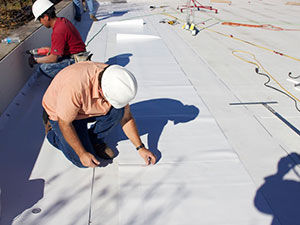
At Century Commercial Roofing, we help business owners in Montrose, Ohio, make informed decisions with professional single-ply roofing solutions. Single-ply roofing consists of flexible, waterproof membranes installed in a single layer, offering durability, energy efficiency, and low maintenance. Understanding how different membranes perform across key metrics is essential for choosing the right roof for your building. For professional guidance or installation, contact Century Commercial Roofing at 330-926-6972, serving commercial properties throughout Montrose, Ohio.
Comparing Single-Ply Roofing Systems
Single-ply roofing comes in several membrane types, each with unique materials and properties. There have been innovations in this space over time and here are the latest types you should be aware of:
- PVC (Polyvinyl Chloride) is a thermoplastic membrane made from vinyl polymer, known for chemical resistance and durability.
- TPO (Thermoplastic Polyolefin) is a single-ply membrane made from a blend of polypropylene and ethylene-propylene rubber, valued for its reflective properties and energy efficiency.
- EPDM (Ethylene Propylene Diene Monomer) is a synthetic rubber membrane that is highly flexible and performs well under extreme temperature variations.
Understanding these base materials helps in evaluating performance, lifespan, and suitability for different commercial roofs.
PVC vs TPO

When comparing PVC (Polyvinyl Chloride) and TPO (Thermoplastic Polyolefin) membranes, the differences become clear across key performance metrics:
- Durability: PVC is highly resistant to UV exposure, chemicals, and oils, making it suitable for industrial environments. TPO is also UV-resistant and performs well under general weather conditions but has slightly less chemical resistance than PVC.
- Flexibility: PVC remains flexible under temperature changes and adapts well to roof movement. TPO is moderately flexible, performing well under typical thermal expansion and contraction.
- Energy Efficiency: TPO is highly reflective, reducing cooling costs in summer. PVC can also be reflective but may have slightly lower energy efficiency depending on the formulation.
- Seam/Attachment Reliability: Both use heat-welded seams for watertightness. PVC seams are generally more proven in chemically challenging environments, while TPO seams perform reliably under standard commercial conditions.
- Maintenance / Lifespan: PVC typically lasts 20–30 years and resists chemical damage. TPO has a slightly shorter lifespan if exposed to chemical contaminants but is still durable with proper maintenance.
TPO vs EPDM
Let’s do the same with TPO and EPDM:
- Durability: TPO offers UV and ozone resistance, while EPDM excels in resisting extreme temperature fluctuations. EPDM may not resist chemical exposure as well as TPO.
- Flexibility: EPDM is extremely flexible, ideal for unusual roof shapes or significant thermal expansion. TPO is less flexible but handles standard expansion and contraction adequately.
- Energy Efficiency: TPO’s reflective surface reduces heat absorption, lowering cooling costs. EPDM, typically black, absorbs heat unless a reflective coating is applied.
- Seam/Attachment Reliability: TPO uses heat-welded seams, providing strong and permanent bonding. EPDM seams are usually glued or taped, which can be more susceptible to weathering over time.
- Maintenance / Lifespan: Both membranes can last 20–30 years. TPO may require seam inspections to prevent leaks, whereas EPDM allows for easier patching when necessary.
EPDM vs PVC
EPDM and PVC membranes differ in their strengths but can be directly compared using the same metrics:
- Durability: EPDM is highly resistant to temperature extremes and UV exposure. PVC offers strong chemical resistance and excellent UV protection.
- Flexibility: EPDM is extremely flexible under thermal expansion and contraction. PVC also adapts well to movement but may be slightly less flexible than EPDM in cold temperatures.
- Energy Efficiency: PVC’s reflective properties reduce cooling costs effectively. EPDM absorbs heat unless a reflective coating is applied.
- Seam/Attachment Reliability: PVC uses heat-welded seams, creating strong, permanent bonds. EPDM uses glued or taped seams, which require careful maintenance.
- Maintenance / Lifespan: Both membranes are long-lasting. PVC may handle chemical exposure better, while EPDM allows simpler repairs if minor damage occurs.
Single-Ply Roofing Installation
Proper installation is critical for maximizing single-ply roofing performance:
- Surface Preparation: Roof decks must be clean, dry, and structurally sound before installation.
- Attachment Methods: Membranes can be mechanically fastened, fully adhered, or ballasted depending on building design.
- Seam Integrity: Heat-welded or glued seams must be inspected to ensure waterproofing.
- Ongoing Inspections: Conduct inspections at least twice a year and after major weather events to detect early wear or seam issues.
Routine inspection and maintenance are essential to ensure all membrane types perform according to their designed lifespan.
Single-Ply Roofing Specialists
Selecting the right single-ply roofing system requires understanding how PVC, TPO, and EPDM perform under key metrics. Century Commercial Roofing helps Montrose, OH business owners evaluate options, ensuring durable, energy-efficient, and low-maintenance roofs. For professional installation or evaluation, contact Century Commercial Roofing at 330-926-6972, serving commercial properties throughout Montrose, Ohio.
FAQ
What is single-ply roofing?
A roofing system with a single layer of flexible membrane for waterproofing and durability.
Which single-ply membrane is best for chemical exposure?
PVC is highly resistant to oils, greases, and industrial chemicals.
Which membrane offers the best flexibility?
EPDM is the most flexible, ideal for unusual roof shapes and thermal expansion.
How long does single-ply roofing last?
With proper installation and maintenance, membranes typically last 20–30 years.