
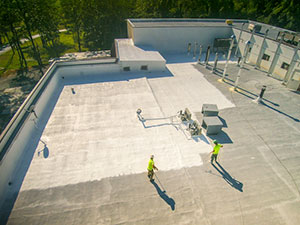
Spray foam roofing is a highly versatile solution for commercial buildings, combining insulation and waterproofing in a single, seamless application. In Montrose, OH, Century Commercial Roofing helps property owners evaluate whether spray foam roofing is the best choice for their building. Call 330-926-6972 today to schedule your consultation with our experts.
Understanding Spray Foam Roofing
By understanding how SPF systems work, the benefits they provide, and the types of roofs they are best suited for, commercial property owners can make informed decisions that protect their investment and improve building performance over time.
What is Spray Foam Roofing?
Spray foam roofing, also called spray polyurethane foam (SPF), is applied as a liquid that expands into a dense, closed-cell foam. Once cured, the foam forms a continuous, monolithic layer that adheres directly to the existing roof surface. Unlike traditional roofing systems, spray foam has no seams or joints, which are typically weak points where leaks can occur.
SPF roofing provides both insulation and waterproofing, creating a roof surface that is highly resistant to water penetration, temperature fluctuations, and minor mechanical stresses. It flows into gaps, uneven surfaces, and penetrations, forming a uniform protective layer that strengthens the overall roof system.
Why does Spray Foam Roofing Work Well?

Spray foam roofing is particularly effective for commercial buildings because it addresses multiple challenges simultaneously:
- Seamless Protection: By eliminating seams, SPF reduces the number of potential leak points.
- High Insulation Value: Spray foam’s R-value of 6.0–6.5 per inch helps stabilize interior temperatures, lowering energy costs.
- Flexible and Durable: The foam can expand and contract with the building, minimizing cracking or splitting.
- Lightweight Application: It adds minimal weight, making it suitable for retrofit projects.
- Adaptable to Irregular Roofs: Spray foam easily covers drains, vents, and other roof penetrations.
These combined features make spray foam roofing a practical, long-term solution for flat and low-slope commercial roofs, ensuring both energy efficiency and leak protection.
Ideal Roof Conditions for SPF
Spray foam roofing performs best when the existing roof structure is stable and free of severe damage. SPF is not recommended for roofs with extensive rust, structural compromise, or significant material degradation. It is most effective in these scenarios:
- “Flat” or low-slope commercial roofs with minor surface wear
- Buildings experiencing minor leaks or ponding issues
- Roofs that require enhanced thermal insulation
- Retrofit projects where minimal roof tear-off is desired
By evaluating these conditions, property owners can determine if spray foam will deliver long-lasting performance and protect the building envelope.
Energy Efficiency Benefits
Spray foam roofing is an excellent solution for improving building energy efficiency. The high R-value reduces heat transfer, helping maintain stable interior temperatures during both summer and winter. In large commercial buildings, where HVAC systems account for a significant portion of energy costs, SPF roofing can contribute to measurable savings over time.
Additionally, many spray foam systems include reflective top coatings that reduce heat absorption, further lowering cooling costs while protecting the roof surface from UV damage. These features make SPF roofing a dual-purpose solution, combining leak protection with energy conservation.
Long-Term Durability and Structural Benefits
Spray foam roofing provides durability across a variety of weather conditions. Its flexible structure allows it to expand and contract with temperature changes, reducing the risk of cracking. When topped with a protective elastomeric coating, SPF roofs are resistant to UV degradation, wind damage, and minor mechanical impacts.
The lightweight nature of spray foam makes it ideal for retrofitting older commercial roofs without adding significant structural load. This adaptability, combined with its ability to conform to irregular surfaces, makes spray foam a highly practical solution for buildings with complex roof geometries.
Signs Spray Foam Roofing Is Right for Your Roof
Knowing when SPF is the right choice is crucial for building owners. Signs that spray foam roofing may be beneficial include:
- Recurrent minor leaks or water infiltration
- Aging roof coatings or minor surface deterioration
- Roofs with poor insulation and high energy bills
- Areas prone to water ponding or uneven surfaces
Early identification of these conditions allows property owners to address potential issues before they escalate into major damage.
Protect Your Roof with Spray Foam Roofing
For commercial buildings in Montrose, OH, spray foam roofing offers a seamless, energy-efficient, and durable solution. When installed over a structurally sound roof, SPF provides a continuous protective layer that strengthens the roof, reduces leaks, and improves interior climate control. Century Commercial Roofing guides property owners through roof assessments, installation planning, and applications to ensure the spray foam system meets the specific needs of each building. For expert advice on whether SPF roofing is right for your commercial property, call 330-926-6972 and speak with an expert today.
FAQ
What makes spray foam roofing unique?
It forms a seamless barrier, eliminating joints and weak points for superior leak resistance.
Can spray foam roofing reduce energy bills?
Yes, its high R-value insulation improves thermal efficiency and lowers heating and cooling costs.
Is SPF suitable for existing roofs?
Yes, it can often be applied over a structurally sound roof, minimizing tear-off.
How long does spray foam roofing last?
With proper application and coating, SPF roofs can last decades while maintaining performance.